Best Colorblind Settings for Valorant & CS2
Color Blindness Types and Their FPS Impact
Color vision deficiency affects approximately 8% of men and 0.5% of women. In competitive FPS games, color blindness creates specific disadvantages:
- Deuteranopia (red-green, most common): Enemy red outlines/highlights appear similar to neutral green backgrounds. Minimap distinction between friendly/enemy colors is compromised.
- Protanopia (red weakness): Similar to deuteranopia — red enemy indicators appear gray or brown.
- Tritanopia (blue-yellow, rare): Blue/yellow game elements affected. Less impactful on enemy visibility in most FPS games.
Valorant Colorblind Settings (2026)
Valorant has the most comprehensive built-in colorblind support of any major FPS: Settings → Accessibility → Color Blind Mode.
Recommended Mode by Deficiency Type
| Color Blindness | Best Valorant Mode | Strength Setting |
|---|---|---|
| Deuteranopia (red-green) | Deuteranopia | 50% |
| Protanopia (red weakness) | Protanopia or Deuteranopia | 50–75% |
| Tritanopia (blue-yellow) | Tritanopia | 50% |
| Normal vision | None (but Deuteranopia at 25% can improve contrast) | 0–25% |
Crosshair Color for Colorblind Players
Your crosshair color choice is critical for colorblind players:
- Deuteranopia: Avoid green and red. Use Cyan or Blue — these colors are visible to deuteranopes and contrast with all Valorant map palettes
- Protanopia: Red is invisible — use Cyan, Blue, or Yellow instead
- Tritanopia: Blue appears unusual — use Red or Green (both visible to tritanopes)
CS2 Colorblind Settings (2026)
CS2 offers colorblind support through console commands. Add these to your autoexec.cfg:
Third-Party Tools and Windows Settings
For games without built-in colorblind modes, or to supplement existing modes:
- Windows Color Filters: Settings → Accessibility → Color Filters → Enable → Select your filter type. System-wide colorblind correction with no performance cost.
- NVIDIA Color Settings: NVIDIA Control Panel → Adjust Desktop Color Settings → Digital Vibrance can increase overall color saturation, making distinctions more visible
- VibranceGUI (free tool): Automatically sets digital vibrance when you launch specific games. Increased vibrance improves color distinction for mild color vision deficiency
- MonitorControl (hardware): Some monitors (ASUS ProArt, BenQ) include built-in colorblind assist picture modes
Sensitivity Is Not Affected by Colorblind Mode
Confirming for players who may wonder: colorblind filters, modes, and color adjustments have zero effect on mouse sensitivity, polling rate, or input latency. These are purely display-layer adjustments. Use our eDPI calculator normally alongside any colorblind settings.
Mathematical Mechanics & Engine Formulas
Understanding aim physics requires breaking down how rendering engines calculate rotation vectors. In 3D space, mouse movement inputs map to angular rotation per count based on the game engine's specific yaw constant:
• CS2 / Source Engine Yaw Constant: 0.022° per count
• Apex Legends Yaw Constant: 0.022° per count
• Overwatch 2 Yaw Constant: 0.0066° per count
• Fortnite Yaw Constant: 0.005555° per count
• Formula: eDPI = Hardware DPI × In-Game Sensitivity
• Formula: cm/360 = (360 × 2.54) / (DPI × Sensitivity × Yaw)
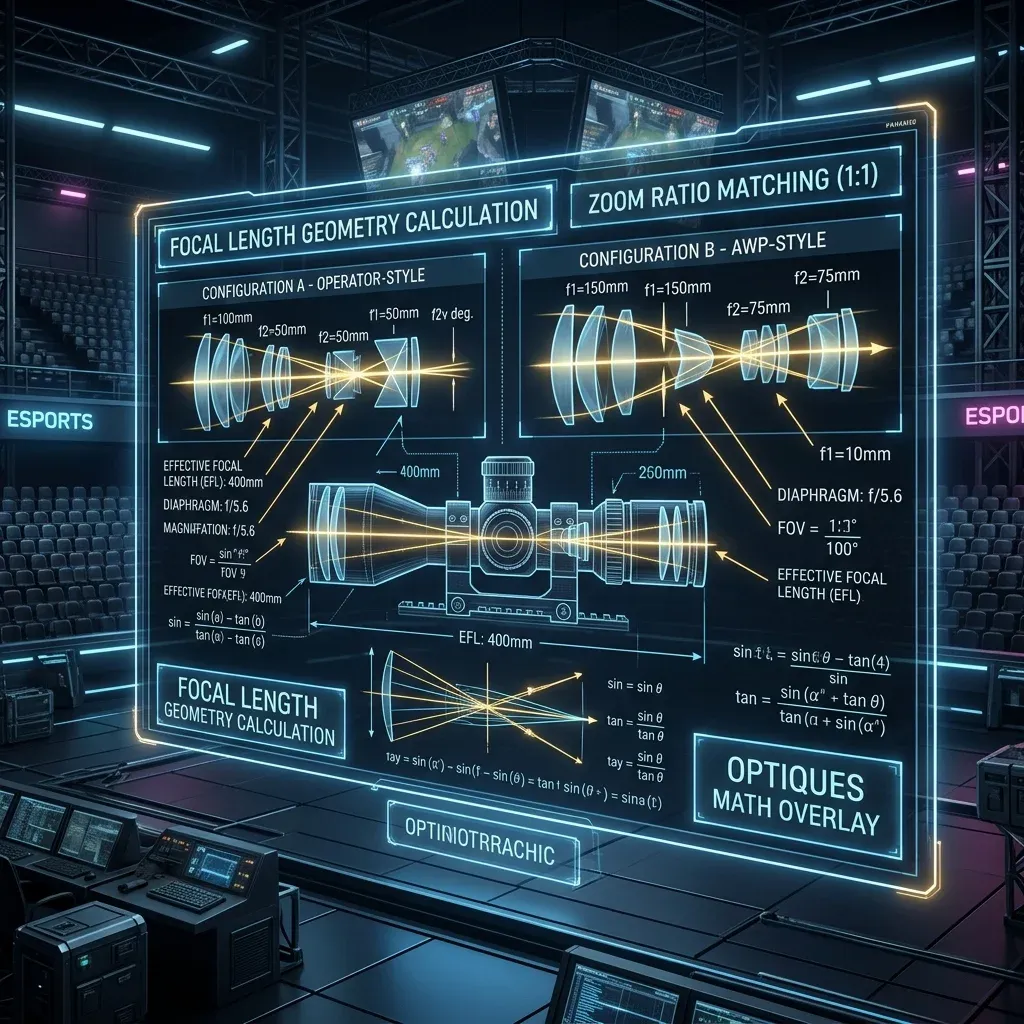
By keeping your physical centimeters per 360 rotation (cm/360) consistent, you maintain identical physical hand travel across titles. However, when switching between different aspect ratios (16:9 vs 4:3 stretched) or vertical FOVs, you must apply 0% Monitor Distance Matching (Focal Length Scaling) to match optical tracking speed at screen center.
Esports Meta & Pro Player Benchmark Data
Looking at publicly available pro settings and general esports sensitivity trends:
- Tactical Shooters (Valorant / CS2): The median pro eDPI sits between 200 and 320 eDPI (approx. 40cm/360 to 65cm/360). Pro players prefer lower sensitivity to maximize micro-correction accuracy and first-bullet headshot precision.
- Tracking & Dynamic Shooters (Apex / OW2 / Fortnite): The median pro eDPI ranges from 2400 to 4800 eDPI in Source/OW2 terms (approx. 28cm/360 to 38cm/360). Higher sensitivity allows rapid 180° sweeps and smooth target tracking during erratic movement.
Step-by-Step Calibration & Actionable Implementation
- Disable Windows Mouse Acceleration: Open Windows Control Panel → Mouse Properties → Pointer Options → Uncheck "Enhance Pointer Precision". This ensures 1:1 raw input without non-linear velocity scaling.
- Set Native Mouse DPI: Use 800 or 1600 DPI on modern optical sensors (PMW3395 / HERO 25K) to minimize sensor input latency by up to 2.5ms compared to 400 DPI while avoiding sensor smoothing.
- Calibrate Desk Space: Ensure your mousepad offers at least 450mm × 400mm of dynamic space. Your cm/360 should allow a full 180° turn from center to pad edge without lifting.
- Verify in Aim Trainers: Benchmark your target acquisition in KovaaK's or Aim Lab (Gridshot / Microflex) for 15 minutes to confirm zero overshoot or undershoot before entering ranked queues.
Frequently Asked Questions (FAQ)
Is higher DPI always better for aim?
Higher DPI (such as 1600 DPI) reduces input latency because the sensor sends motion packets more frequently per millimeter. However, going above 3200 DPI can introduce unwanted sensor noise or smoothing on certain optical sensors.
Should I match my hipfire sensitivity to my ADS sensitivity?
Yes! Utilizing 1:1 focal matching (0.847 in Valorant, 1.0 in CS2/Apex) aligns your focal muscle memory between hipfire aiming and scoped targeting.
🎯 Lock In Perfect 1:1 Aim & Pro Consistency
Tired of daily aim inconsistency? Calibrate your physical cm/360, scope matching, and sensor latency. Get the complete Precision Aim System (4-Part Technical Manifestos) today for only $9.00 USD!
Unlock Elite Precision ($9) ⚡Dalto Outlier
Creator, DCPROSENSDalto built DCPROSENS to help competitive FPS players convert sensitivity, calibrate DPI, and keep their aim consistent across games.